Build your business decisions on your company's data
- Are your campaigns set up well?
- How's your capacity utilization?
- Which marketing channel brings the most revenue?
- Are your key business metrics improving?
Data analytics for businesses: we help you see your company clearly. View your marketing, sales, and financial data in one place, so you can make better business decisions faster.
- spend at least HUF 500,000/month on customer acquisition
- store their data across multiple systems
- want to make decisions faster and with more confidence
 Google Ads
 Meta Ads
 CRM
CRM Webshop
 Google Sheets
The Data Diagnosis™ methodology
Good business decisions start with an accurate diagnosis.
Data discovery
We get to know your business and your current data sources.
Data diagnosis
We uncover the gaps and identify which business questions remain unanswered.
Action plan
We put together a proposal for how to build your data platform.
Implementation
We build the system.
Ongoing review
Monthly analysis, improvements, and answers to new business questions.
How can we help?
Businesses generate huge amounts of data every day — marketing, sales, finance, customer management, website…
We bring all of this into one place, so you can see every piece of information together. From that combined dataset, we can then find answers to your business questions.
Marketing & customer acquisition
- Which campaign brings the most profit?
- Which campaign should I pause?
- How much does a new customer cost?
- Is Google Ads or Meta Ads better for me?
Business questions
- Where is unused capacity?
- Which service generates the most revenue?
- How are bookings trending?
Executive decisions
- Automated reports
- AI-powered analysis
- Faster, more confident decisions
Not sure what questions you should even be asking?
Good decisions and good data analysis always start with a good question.Most business owners sense they have plenty of data available, but aren't sure which relationships are worth examining. That's exactly what the first consultation is for.
Request a free consultationWhat happens to your data?
We bring the data generated across your company’s systems into a centralized data warehouse, so all analysis can be carried out in one place.
We get to know your business
We answer your business questions
Data-driven decision support
- A dashboard so you can see everything in one place
- AI analysis — for more complex questions
- Automated reporting — updated daily
- Monthly consultation — drawing conclusions together
- New questions will keep coming up
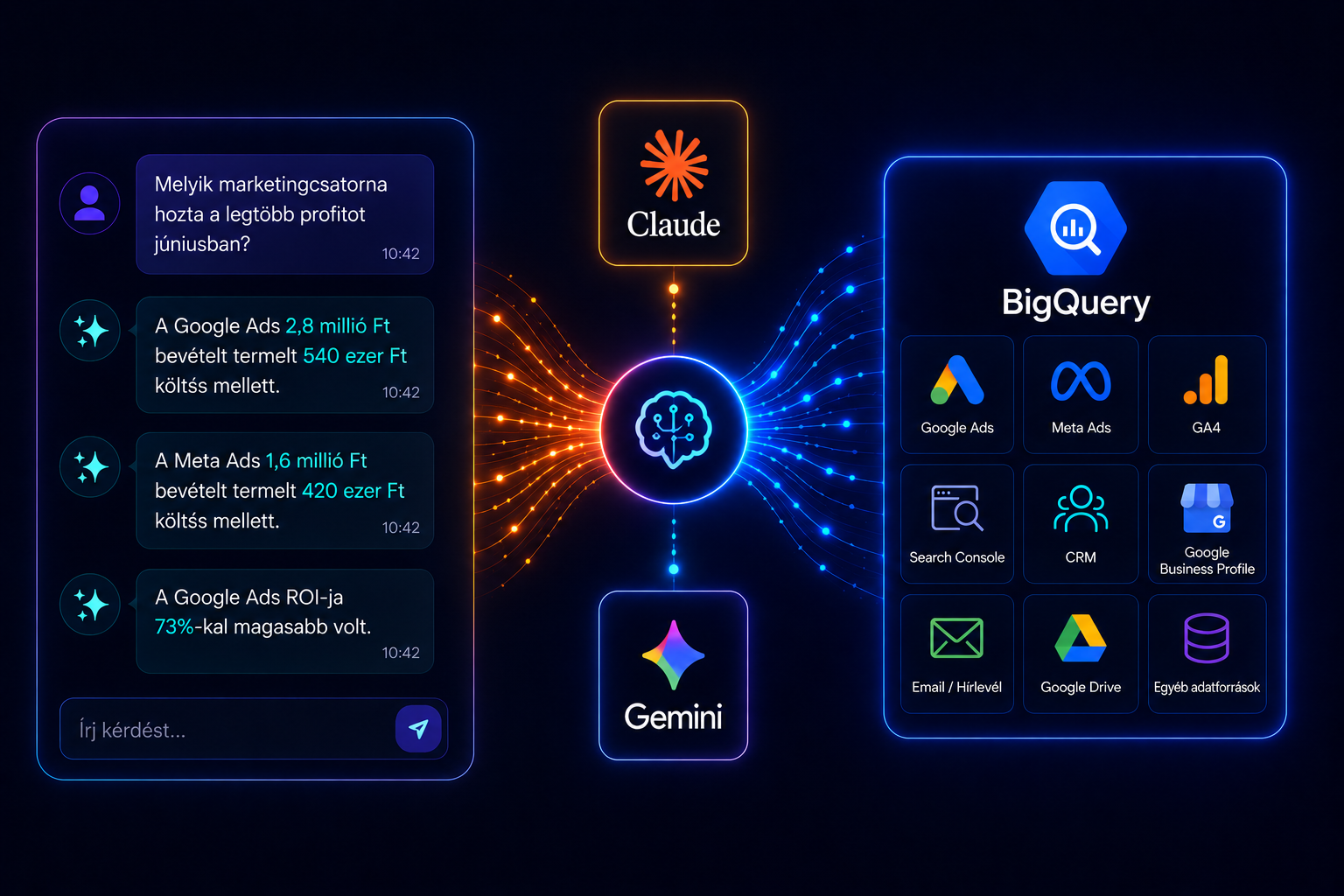
Chat with your data
Alongside the dashboard, we also build an AI-powered (Claude or Gemini) chat interface to quickly answer complex, one-off questions — and if needed, that analysis can be added to the dashboard too.
Choose how deep a view of your business you want
Starting system build price from HUF 140,000 (GA4 + Google Ads). The cost of working together depends on the number of connected data sources, the condition of the data, and the business questions to be answered.
Data diagnosis
A free, no-obligation consultation of up to 30 minutes before any package — we look at what systems and data sources you have, and which package fits best. A quote is prepared based on this.
I want to see my marketing clearly
A clear marketing report built from your Google Ads, Meta Ads, GA4, Search Console, and Google Business Profile data.
- Which campaign generates the highest return
- Google and Meta results in one place
- Campaign comparison and auditing
- Marketing ROI and conversions
- Web analytics (GA4)
- AI-powered analysis of Google reviews
- Daily data refresh
- Executive consultation on the results
I want to see my whole business clearly
Find out what actually turns into a customer, purchase, or inquiry — marketing and business results connected.
- Everything in the Marketing package
- Marketing + CRM + finance connected
- From customer acquisition to revenue, in one place
- Customer and service-level analysis
- Capacity utilization
- AI-powered business analysis
Enterprise — your own data platform
Full-scope data engineering service for complex data environments — any number of data sources connected, with custom analysis and ongoing development.
- Multiple locations
- Multiple data sources
- Custom business analysis
- AI-powered decision support
- Ongoing development
- Priority support

Attila Budácsik
I spent 10 years working on government IT systems with large databases, then several more years on marketing and video projects, where I saw firsthand how business decisions get made without data — or based on misleading reports.
Today I help SMEs bring their marketing, CRM, financial, and web data together — out of separate silos and into one clear, unified decision-support system for management.
View LinkedIn profileConfidential data handling!
Throughout our collaboration, your company data, customer data, and business information are protected under contract.
Frequently asked questions
Short answers about when it's worth considering business data analysis, what data you need, and what you get at the end of the process.
How do I know if my company's data can be analyzed?
It's worth getting started if you have at least a well-built website with GA4 tracking and event measurement, your financial or sales data is accessible, and ideally you also have some kind of CRM, booking system, webshop, quoting tool, or customer database. It's fine if the data lives in different places — that's exactly the point: to bring it all together and make it transparent in one data warehouse.
How is this different from a Looker Studio dashboard?
The dashboard is just the visible surface. The real value comes from cleaning up and connecting the underlying data first: marketing, web analytics, CRM, bookings, invoicing, or financial data. That way you don't just see how many clicks or leads came in — you see which channel and which customer type actually drives real business results.
What data do I need for the analysis?
The most important data is usually your website and marketing measurements — e.g. GA4, Google Ads, Meta Ads — plus your business-side data: revenue, quote requests, purchases, bookings, customers, invoices, or CRM data. The better marketing can be connected to business results, the more valuable the analysis becomes. We can also connect Excel spreadsheets.
How long does it take to build?
A simpler marketing dashboard can usually be launched within a few business days, assuming access and data sources are in order. For a more complex decision-support system that also includes CRM, financial, or operational data, it's more realistic to plan for a 2–4 week rollout.
Is it enough to just have Google Analytics connected?
As a starting point, yes — but GA4 on its own usually doesn't show the full business picture. The real value begins when we can connect your web and advertising data with what actually turned into a lead, customer, booking, purchase, or revenue.
What if I don't have a CRM system?
That's not necessarily a problem. If your customer, order, quote-request, or revenue data is available in Excel, Google Sheets, invoicing software, or any other exportable format, we can already work with it. Useful business analysis is possible even without a CRM — what matters is knowing where the data needed for decisions is actually generated.
What kind of questions can I get answers to?
For example: which marketing channel brings the most valuable leads, which campaigns pay off better, where leads are getting lost, which customer types spend more, which periods are stronger, or whether your website and ads are actually supporting your business goals.
Is this a one-time analysis or an ongoing dashboard?
Both are possible. A one-time analysis helps you clearly see a given period's performance and the main relationships in the data — and even a one-time analysis involves bringing all the data together in a single database for the analysis. A dashboard is useful if you want to track your key metrics on an ongoing basis — that involves continuous data refreshing, which carries a monthly fee and can also include custom analyses.
Do I need technical knowledge on my end?
No. You need to know your business and your goals: where your customers come from, what you want to measure, and which decisions you want to base on solid ground. The technical part — mapping, cleaning, connecting, and visualizing the data — is my job.
What's the tangible outcome?
The goal isn't to give you yet another spreadsheet — it's to help you see how your company runs, more clearly, in one place. The outcome can be an executive dashboard complete with recommendations, a business analysis, a channel performance report, a customer value analysis, a revenue overview, or a decision-support system that helps you find the connections that matter.
Will my data be secure?
Yes. Data is handled confidentially, and I only work with the information needed for the analysis. The goal of our collaboration is never to expose your data publicly — it's to help management make better decisions from it. Everything is presented through a protected system in Google Looker Studio.
What if my data is a mess?
That's a common situation. At many businesses, data lives in separate systems, exports, or spreadsheets. The first step is exactly that: figuring out what's usable, what needs cleaning up, and what's missing so we can get a more reliable picture of the business.
When is it not yet worth starting?
If there's no tracking on your website, no accessible sales or financial data, and customer acquisition can't be tracked in any form, it's worth getting the basic measurement in place first. Analysis becomes genuinely valuable once your website, marketing, and business results are at least measurable to some degree.
Why isn't it enough to just look at ad accounts?
Ad platforms mainly show you clicks, impressions, or conversions. From a business standpoint, though, the more important question is whether those actually turned into a real lead, customer, or revenue. That's why it's worth examining marketing data together with business data.
Let's figure out what system you need
In the first step, we map out your data sources, what can be connected or exported, and the business questions you'd like answered.
To start, pick the data sources you have — drag them in, or just click them. We'll send the summary to you by email together with the form below.
Drag data sources here, or click them on the left — they'll collect here.

